Showing posts with label HHL_Conference. Show all posts

Saturday, October 18, 2008

Hand Held Learning Conference Day 2 Part 2

Steven Johnson Everything Bad is Good for you

Everything Bad is Good for You: How Popular Culture is Making Us Smarter: How Popular Culture Is Making Us Smarter


Steven takes a third way approach to some of the popular myths around today's popular culture. In short summary computer games are not mindless distractions, they actually require thought and effort and a game like SIM CITY is an example of where the player has to hold a tremendous degree of interlinked information in their head.

I remember reading Stevens book last summer and it was this thought about games that struck me. I think he said something along the lines of nobody actually points out that games are often very hard. At the time I was working with a school and trying to prove that games could add value to the classroom, so this thought appealed greatly. His premise with all of this is that we are getting smarter and indeed we need to be smarter as many products we use in pop culture demand that we engage our brains.
Games also require a good deal of work and problem solving. He also points out that collaboration opportunities which games afford, either through multi player games, or through the forums where people hang out to try to find the answers to they need to proceed to the next level.
Alongside games he also compares how TV has developed from Gilligan's Island to Lost. Or from Dallas to Desperate Housewives. He argues that these shows work on a number of levels and demand that viewers are able to hold onto oblique references from previous episodes. Thus spawning huge fan experts who would plot maps and document story arcs on sites like Wikipedia and sites dedicated to the show.
He argues that TV shows like Lost and I'd argue Doctor Who, borrow a lot from computer games, as they present the viewer with a multi layered world, and a world that requires you to take the keys form level one further into the gain, even to level 12 or 13, as it is in the final that such keys finally begin to make sense.
I recommend reading Steven's book if only to affirm to yourself that it is OK to play games for hours at a time, and to waste long hours in discussion about the meta narratives of Heroes.
And while you are waiting for the postman to deliver your copy, you can watch his talk at the Hand Held learning conference, embedded below:

Wednesday, October 15, 2008

Hand Held Learning Conference Day 2 Part 1


Here is the programme for today and some notes from my scrap blogging with my ever dying laptop


09:30 - Industry Announcements


Stuck on a National express train somewhere out of Stratford
09:45 - Welcome & Introduction


Tension between Graham and the next speaker over home access
10:00 - Opening Address – Andrew Pinder, Chairman, Becta (bio)


Passionate about kids getting good ICT teaching and kit - especially if you are poor
10:20 - Steven Berlin Johnson, Cultural Critic & Writer (bio)


I felt smug because I had read his book this summer - so this wasn't new to me but still good to hear him in the flesh and its all so true


11:00 - Break – refreshments, networking, exhibits


Lots of coffee
11:30 - Danah boyd, Social Media Scientist (bio)


Fantastic- inspirational my new online heroine
12:15 - Laurie O’Donnell, Director of Learning and Technology, Learning & Teaching Scotland (bio)


Interesting slides and first fifteen minutes but we then descended into open questions - this is when i kicked into engaging with the other Pictochatters in the room
13:00 – 14:30 - Lunch – finger buffet, networking, exhibits

Networking with others and standing by the kitchen doors to try to secure some lunch - a cross between Pot Noodle and a Kebab


14:30 - Break out Sessions -


I went to:


Game On


Chaired by Chris Deering, former President of Sony Computer Entertainment (bio) Do games consoles and off the shelf games titles have a role in learning?How game-based learning is challenging all the rules?


This session featured Derek Robertson and our own Dawn Halybone.


Networking with others and standing by the kitchen doors to try to secure some lunch - a cross between Pot Noodle and a Kebab


Today was the best day of the conference for me -I loved Danah Boyd's talk on Soc ail Networking and Derek's passionate rallying cry to us all to get gaming in the classroom was like William Wallace with a giant Nintendo Stylus held aloft, who can not be moved by his infectious enthusiasm and his cogent arguments around context for learning, progression, differentiating and Vygotskian talk for learning around a small screen.


Scrap Blogging from the day...


Graham showed us a video of his 3 year old daughter playing with the DS - doing some scribbly drawing and also taking her Nintendog for a walk. We then saw her playing Club Penguin with her sister.


This is a bit like the video I begin my talks with - the one where Leo learns to use the mouse-


Watching the video two things struck me:


Gosh I thought Club Penguin was a Key Stage 2 phenomenon


I need to give my kids my DS to play with and stop limiting them to just a mouse

___________________________________________________________________

Andrew Pinder

There are some Becta presentations which leave me annoyed and irritated,as the speakers can appear stuffy, a bit too cerebral and a t worst out of touch. But I was encouraged and inspired by Andrew Pinder the chairman of BECTA.

He believes it is a disgrace that not every child in the country has access to good ICT both in terms of a home connection, a school rich in IT teaching and learning and a school where the infrastructure is effective. Sometimes he says it is puzzling for children that the school IT is worse than the IT the children experience at home.

Pinder meets many teachers who are annoyed that they can not set homework for the kids to do online, because the children are not equipped with a PC.

As this was a Handeheld confernec there was slight tension over the device that the recipients of the vouchers for home access would get, and Pinder did not rule out mobile dveices but emphasied that there would need to be a screen that both child and parent could see.

BECTA will be supporting and assisting the government in implementing the new Home access scheme. They are also driving a campaign on next generation or 21st century learning, something like that anyway.

As one questioner asked isn't the question about 20Th century teachers. Good point, but it is not enough to bash older teachers who do not get excited by technology. All teachers need permission, context and examples of good practice , in order to use ICT more creatively and effectively. Frankly they also need some money and an infrastructure that works.

I do hope we see a big push from BECTA on Innovative and effective ICTs in 2008-9. Yes, when ICT is used well it can have an impact on both Reading and GCSE score, but it can also make school a far more exciting and relevant experience.

I have embedded the talk here, and I thank Handheld Learning for allowing us Bloggers this embed option.


Tuesday, October 14, 2008

Hand Held Learning Conference Day 1

This week I am @ the handheld learning conference in the Barbican, though I hasten to add this is not all week, I am in schools and Subject leaders too!

I am here for two reasons:
1 To find further direction and vision for ICT
2 To Support our Redbridge Delegates : Nicholas Hughes and Dawn Halybone, who are both presenting - I sort of feel like their Dad proudly cheering them on -

I badly typed copious notes throughout the two days and I'll attempt to get posted what I can and what I think is worth sharing and linking to.

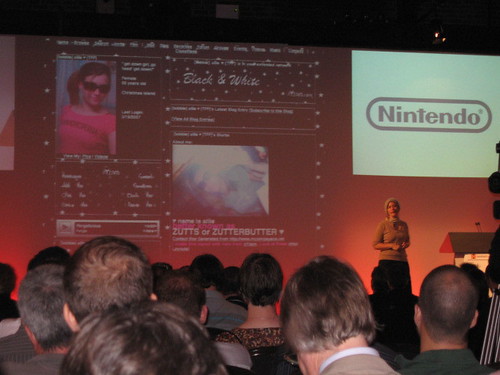
Andrew Pinder from Becta on a giant Screen


This was Andrew Pinder from Becta talking about and staunchly defending the Home Access project earlier today - I loved his passion and determination.


Mondays Blogging Scraps

Today I am here @ the Handeheld learning Confernce in the Barbican. There is a real buzz of excitement in the air and lots to see. The first session of the day takes place upstairs and is a showcase of excellent, outstanding and exciting work in ICT. I have summarised some of my thoughts below:

Session 1 Clunbury school in Shropshire
Clunbury is an isolated school and therefore they do well to be making use of new technologies outside of the metropolitan excitement of somewhere like London or Wolverhampton. I was pleased to see this school present as I had recently watched their programme on Teachers TV.

The head showed us how the school had been using blogging and podcasting and he commented how children with SEN really enjoyed Podcasting. Nice to hear this, but I’d like to know what he means by this umbrellas term of SEN. This phrase of 'the SEN children really got into it', is often bandied around in such innovation reports, but exactly what sen group and how we rarely hear.

We heard a lot about the use of Nintendo DS and it is good to see that this technology is now sneaking into the mainstream. We need to see other schools and authorities experimenting and trying this technology, other than just Dundee and good old Derek.I have to say though the images we saw of young children using the device were inspiring, I was not impressed with the video which showed the device in action.

We saw a group of children being sent a question via Pictochat and then working together to answer the question. Yes it is great that these devices have wireless capability but surely the point of the device in Maths is gaming challenge and this is the principal motivator.
Sitting next to Dawn she has reminded me that the challenge/competitive element is also about being able to improve themselves and reduce or improve their score.
The question I have to ask about any technology is – what does it offer that traditional methods do not and having witnessed Pictochat in action I felt that simply asking the question was faster than sending it via Pictochat and whats more when a question is more detailed as in a problem – Pictochat will not let you dictate such a detailed piece of text.Simply sending a problem by a device doesn't make it any more exciting.

But I have been wrong before

That was yesterday and today I have reflected a little and also witnessed a giant impromtu Pictochat session in the main hall, which wa sone of those moments, where we were both listening and discussing and it was debatable who was actually in control of the room! Today I think there is a place for Pictochat, perhaps as Derek suggested in emergent writing.

Session 2 Nicholas Hughes - Robo- Control
This was Nicholas talking about his Robosapien work. Obviously I did not make notes during this session. There was a lot of interest in the coffee area following his talk as Nicholas and the mini Robot roamed the drinks area. I think the boy did well to convey the childrens' enjoyment factor of ICT Control with a popular robot. Read more on his blog.


Nicholas presents on his Robo Project

Session 3 - Gavin Hawkins Stow Heath Junior School- Wolverhampton

Gavin's school was involved in one of the 2002 Text bed pilots with PDAs. They decided not to give these devices to teachers, but instead gave them to the children. This project grew from 15 devices to over 200. Looking at the video he showed us, these eventually became EDAs, those lovely rubberised PDAs that Steljes used to sell.

They were bale to afford these by making/taking regular contributions form the parents - about £1.50 a week.

We watched a video of this project which showed children using the device at home and school. They started the day by catching up with news from Espresso. Later that day they might use other applications like the Mind Mapping software or animation tools, we saw a child use this animation software to demonstrate the water cycle.- Great!

The EDA Project was part of Learning2Go in Wolverhampton. One student commented, 'they are better than computers because you can just carry them around in a bag'. A teacher said that she thought the children seemed to be learning more and doing more . The use of the EDA allowed the extension of learning to home where children connected the device to their PC and completed their homework and often talked with their parents about what they had been doing.

One problem that the school needed to surmount was that of connecting these devices to the big screen. Teachers were concerned that they couldn't see what the pupils were doing on the device all of the time, they also asked how could they collect the work that children had done on the devices.
Overtime they tried various devices which could display the EDAS- I guess a bit like AB Tutor for EDA/PDAs. These were:

My Mobile which is free - but I can't find it
Dotpocket - http://www.dotpocket.com/

Eventually though the school worked with Steljes to develop the use of synchroneyes. We saw a video of this in action and this was excellent - children were annotating and sketching out their calculations on screen and the teacher was able to hold them all on task because he could display all the devices on screen, and I assume he could then save these screen shots as assessments.

This was the second time I have seen EDAs in use, last month @ the NAACE conference, when Ruth Jack talked to us about how she had use the GPS function and Wildkey software to bring a visit to West Stow museum to life. When she made the comparison between the clipboards in the rain scenario and the thrill children got from taking and receiving images digitally, I was convinced that these devices added real value to an otherwise potentially dull visit. Also the device and Wildkey would enable all users to access the same information, rather than the unreliable chaos you often get when you travel with six parent helpers and a TA.

I youtubed the EDA and Stow Heath and came up with following:


Session 4 -Willington C of E school

This school were innovating but with ordinary office tools. They used what they and Andy Black described as an innovative approach to electronic assessment. This was basically a repository for all of the work in Foundation and beyond that allowed teachers to hyperlink assessment statements to examples of work. So a teacher would highlight a curriculum statement and hyperlink to an image or a scanned or typed piece of work.

They also used track changes in word to electronically mark work furrier up the school. I really liked the evidence base the had built up in Foundation and the way they described personalisation as recognising the uniqueness of every child. My only worry was the over reliance on electronic work and marking further up the school, did this means that teaching of handwriting took a back seat. I am sure it probably didn't.

Read more here

http://www.willingtoncofe.durham.sch.uk/

There were further sessions on ICT in secondary context at this point, but they are not included here, as I was a bit blogged out by this point. Well done to Andy Black for organising this session of sharing of good and innovative practice.